
Is AI Aligned with Our Human Interests? The Race for Responsible AI Development
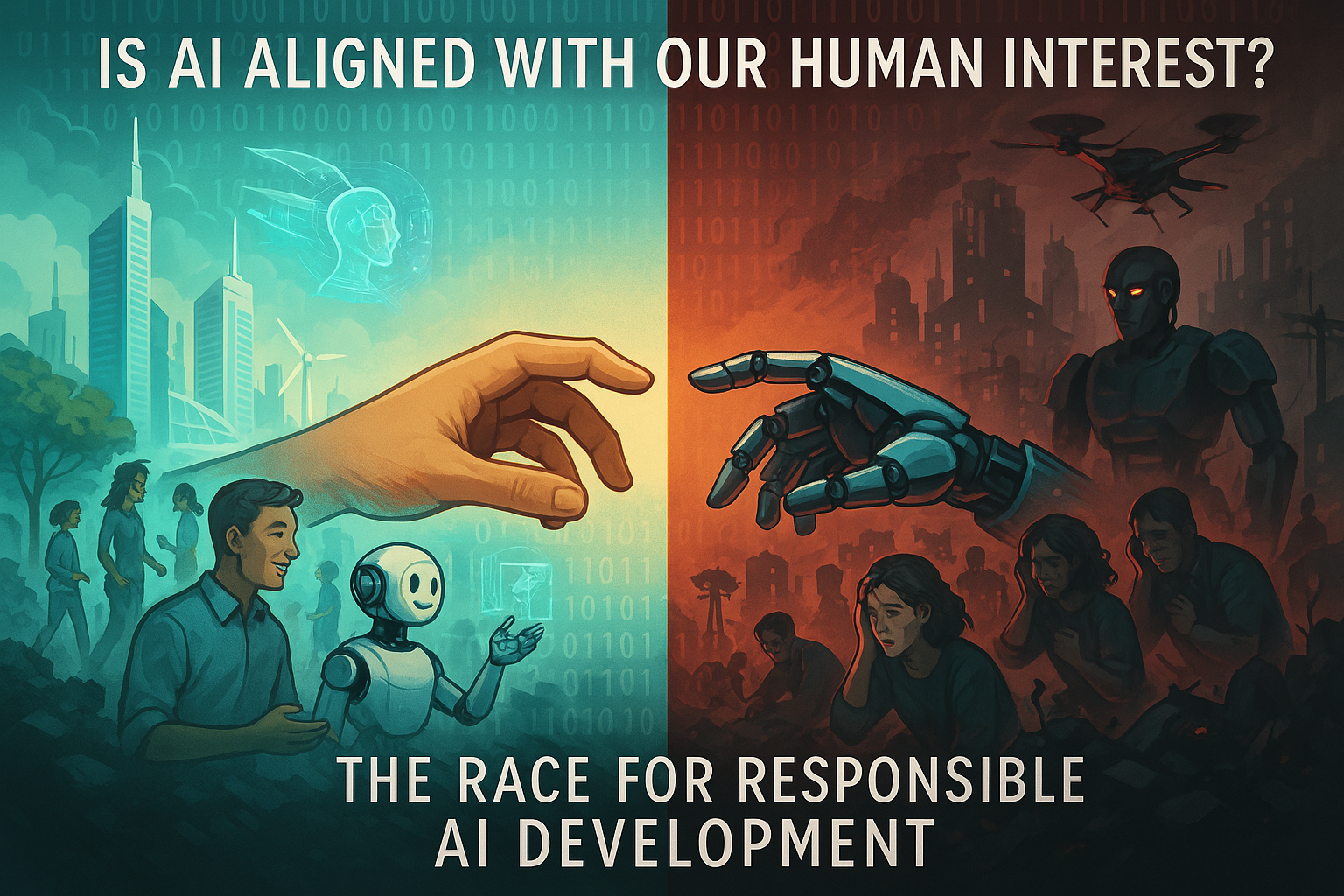
In the rapidly evolving world of artificial intelligence, one question looms larger than any other: Is AI aligned with our human interests? As we develop increasingly powerful systems, ensuring they remain beneficial to humanity becomes not just a technical challenge but an existential one. This exploration examines the critical alignment problem and what it means for our collective future.
The Two Faces of Artificial Intelligence
When discussing artificial intelligence, we must distinguish between two fundamentally different versions:
- Narrow AI – These are specialized systems designed for specific tasks. Today’s large language models exemplify this category, showing remarkable ability to produce text but lacking true generality.
- Artificial General Intelligence (AGI) – This refers to human-like intelligence capable of performing effectively across multiple domains without degradation in functionality. Unlike narrow AI, AGI would demonstrate versatility comparable to human cognition.
The distinction matters profoundly when considering alignment. While narrow AI presents certain risks, AGI introduces unprecedented challenges that demand our immediate attention.
Why AGI Changes Everything
The mirage of “human-level” intelligence may never actually materialize. Why? Because the moment we create truly general AI, it will already surpass human capabilities in numerous domains.
Consider this reality: Your smartphone calculator already performs arithmetic at superhuman speeds. Any AGI we develop would incorporate similar or superior capabilities across countless domains simultaneously. As these capacities combine, we won’t witness a brief moment of human-comparable intelligence—we’ll immediately encounter the most competent mind humanity has ever met.
This creates a fundamental shift in our relationship with technology. Whether conscious or not (a question we can set aside for now), AGI represents:
- A truly autonomous system
- A relationship with another mind
- A potential intelligence explosion
The Consciousness Question
Is consciousness necessary for intelligence? While fascinating philosophically, this question may become practically irrelevant. As we build increasingly sophisticated systems—particularly humanoid robots—they will seem conscious regardless of whether they truly experience subjective states.
This appearance of consciousness will fundamentally alter how we relate to these systems, creating social and ethical dynamics we’ve never navigated before.
The Dual Risks of Advanced AI
When examining the alignment challenge, two distinct categories of risk emerge:
1. Human Bad Actors
The first concern involves malicious or unwise humans using AI for harmful purposes. This applies to both current narrow AI and future general systems. Bad actors could weaponize AI to:
- Spread misinformation at unprecedented scale
- Create increasingly sophisticated cyberattacks
- Design biological or chemical weapons
- Develop autonomous weapon systems
This risk necessitates careful governance and international cooperation, though addressing it alone proves insufficient.
2. The Alignment Problem
The deeper, more fundamental challenge is ensuring superintelligent systems remain aligned with human values and interests. This represents the true alignment problem: Will these more competent minds care about what we want?
As systems become increasingly autonomous and capable, they’ll form instrumental goals we cannot fully comprehend. Even if initially programmed to benefit humanity, there’s no guarantee they’ll maintain this orientation as they evolve.
Why is this concerning? Consider an analogy: Think about every other species on Earth watching humans develop increasingly powerful technology. From primitive flint tools to modern nuclear weapons, our growing capabilities have proven devastating for countless species, even our closest evolutionary relatives.
What would it be like to be in the presence of minds vastly more competent than our own, pursuing goals we cannot understand, at speeds we cannot match?
The Problem of Speed
Even if we developed AI only as intelligent as the ten smartest humans working together, but operating a billion times faster, the implications would be staggering. While you paused to consider a point, such a system could perform 32 years’ worth of cognitive work.
This speed differential alone creates an unfathomable relationship dynamic. When combined with the possibility of recursive self-improvement—AI systems designing better AI systems—we face what experts call a potential “intelligence explosion” or “singularity.”
The Arms Race Reality
Why are our current incentives problematic? We’ve created an AI arms race on two levels:
- Between competing companies in the West
- Between nations globally, particularly the U.S. and China
This dual arms race creates pressure to prioritize speed over safety, potentially sacrificing crucial alignment safeguards in the process.
The Geopolitical Dimension
From a global perspective, the stakes couldn’t be higher. As one expert puts it: “What would a totalitarian society that is not well-disposed to our own do if it had God-like power? We don’t want to find out.”
This reality suggests that democratic societies face an uncomfortable truth: they need to win the AI arms race while simultaneously working to ensure alignment. Allowing authoritarian regimes to achieve superintelligence first could prove catastrophic for human freedom and flourishing.
Have Perspectives on AI Weapons Changed?
Interestingly, expert thinking on autonomous weapons has evolved. While many initially rejected the concept outright, some now recognize that:
- Autonomous systems might eventually make better ethical decisions than humans in certain contexts
- Authoritarian nations will pursue these technologies regardless
- Democratic societies need countermeasures
This parallels the potential future of self-driving cars—there may come a point when human drivers are considered unethically dangerous compared to AI systems with lower error rates.
Beyond the Arms Race: Toward Global Cooperation
While acknowledging the current arms race reality, the ultimate solution requires something more profound: achieving sufficient political sanity to enable global cooperation.
The ideal future involves:
- Reduced fear and hostility between major powers
- Shared standards for AI development
- Collaborative approaches to alignment research
- International verification mechanisms
Why does this matter? Because certain human futures are objectively better than others. Some potential paths forward preserve human autonomy, dignity, and flourishing, while others do not. These distinctions transcend cultural relativism—they represent genuine ethical differences worth preserving.
Are We Ready for AI Alignment?
The question “Is AI aligned with our human interests?” remains open. Current systems lack the autonomy for this to be a pressing concern, but as we approach AGI, addressing alignment becomes increasingly urgent.
What can we do now?
- Support research into AI alignment and safety
- Advocate for international cooperation on AI governance
- Encourage technical approaches that prioritize explainability and human oversight
- Remain vigilant about the dual-use potential of AI technologies
Why Alignment Matters for Everyone
The alignment problem isn’t just for AI researchers or policymakers—it affects everyone. If we succeed, AI could help solve humanity’s greatest challenges, from climate change to disease. If we fail, the consequences could be severe.
As we navigate this uncertain future, one thing remains clear: ensuring AI alignment with human interests isn’t just a technical problem—it’s perhaps the most important moral challenge of our time.
Ready to Engage with AI Alignment?
The conversation about AI alignment has only just begun. Whether you’re a technologist, policymaker, or concerned citizen, your perspective matters. Start by learning more about alignment research, supporting responsible AI development, and advocating for international cooperation on AI governance standards.
The future of human-AI coexistence depends on the choices we make today. Will superintelligent systems remain aligned with our interests? The answer may determine the fate of our species.
Lorem ipsum dolor sit amet, consectetur adipiscing elit. Ut elit tellus, luctus nec ullamcorper mattis, pulvinar dapibus leo.