
Something Weird Happens Inside A Black Hole: The Mind-Bending Science Explained
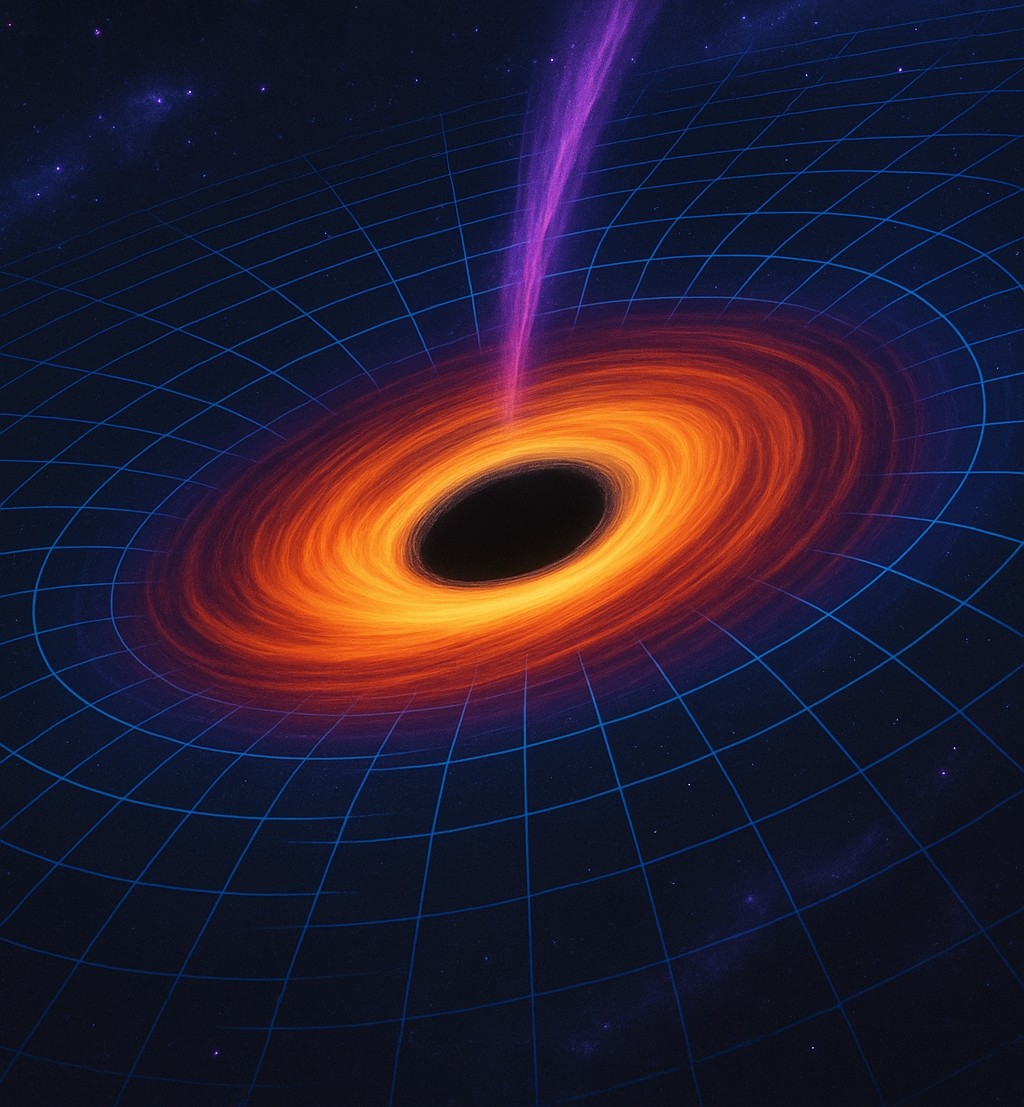
The Ultimate Cosmic Abyss
Imagine being pulled toward a dark abyss in space, feeling stretched as reality warps around you. You’re falling into a black hole—one of the universe’s most astonishing phenomena. Some black holes are so massive they could fit over 60 solar systems across them, with masses up to 100 billion times our sun. Once you cross a certain threshold, nothing can escape… or can it?
Recent cutting-edge research reveals fascinating new insights about what might actually happen inside these cosmic enigmas. Let’s explore the science behind black holes, what would happen if you fell into one, and the mind-bending theories challenging our understanding of space and time.
What Exactly Is a Black Hole?
A black hole forms when an enormous amount of mass collapses into an incredibly tiny space. To visualize this: if you could compress our sun down to just 3 kilometers in radius, the gravity at its surface would become so intense that not even light could escape its gravitational pull.
The escape velocity—the speed needed to break free from a gravitational field—would exceed the speed of light. Since nothing can travel faster than light, absolutely nothing can escape from this region of space once it crosses what we call the “event horizon.”
For decades, black holes existed only as theoretical mathematical quirks in Einstein’s equations. Scientists eventually confirmed their existence by measuring the warped movement of stars, galaxies, and gases around seemingly empty patches of space. We now know black holes are abundant throughout our universe—some estimates suggest there may be up to 40 quintillion of them.
Finding Black Holes: Accretion Discs and Gravitational Distortion
How do we detect something that emits no light? One way is through their accretion discs—the spiraling material orbiting violently around black holes that heats up and emits detectable light.
The famous first black hole image from 2019 doesn’t show the black hole itself but rather this glowing accretion disc. Interestingly, we see both the disc in front of and behind the black hole due to the extreme gravitational lensing effect. Light from behind the black hole bends around it before reaching our eyes, creating a distinctive ring-like appearance from all angles.
The Astonishing Scale of Black Holes
Black holes come in dramatically different sizes:
- Stellar-mass black holes: Like J1650, with a diameter comparable to Manhattan but a mass 3.8 times our sun
- Intermediate black holes: Like Messier 15, about twice Earth’s diameter with 4,000 solar masses
- Supermassive black holes: Like Sagittarius A* at our galaxy’s center, with a mass 4.3 million times our sun
- Ultra-massive black holes: Like M87, weighing 5.4 billion suns and capable of fitting our solar system inside it four times
- Monster black holes: Like TON 618 and Phoenix A, with masses 66-100 billion times our sun
Despite their enormous mass, even supermassive black holes are relatively compact. The black hole at our galaxy’s center would only extend to about 1/5 of Mercury’s orbit if placed in our solar system.
Falling Into a Black Hole: Two Different Perspectives
What would happen if you fell into a black hole? The answer depends entirely on whose perspective we consider—yours as the unfortunate traveler, or an observer watching from a safe distance.
Your Experience: The Free-Fall Journey
If you were falling toward a black hole in a properly insulated spacecraft, you would initially feel nothing unusual—just weightlessness, similar to astronauts on the International Space Station. You’re in free fall.
As you continue falling, you would eventually cross the event horizon—the point of no return. Surprisingly, you wouldn’t notice anything special at this moment. No alarms, no flashing lights, no dramatic sensations. Space would look normal, and you would feel normal.
But as you fall deeper, gravity begins increasing dramatically. This is where things get uncomfortable.
Spaghettification: The Gravitational Stretch
The closer you get to the black hole’s center, the more extreme the difference in gravitational pull between your feet (closer to the black hole) and your head becomes. This differential pull creates a stretching effect called “spaghettification.”
This isn’t just stretching—it’s also crushing from the sides. The experience would be both bizarre and catastrophic. Eventually, the forces become so extreme that your body would be pulled apart atom by atom. Even the subatomic particles themselves would ultimately be torn apart as everything races toward the singularity.
The Observer’s Perspective: Time Dilation and Redshift
While your experience is dramatic but brief, someone watching you from a distance would see something entirely different due to Einstein’s relativity.
As you approach the black hole, an outside observer would see your time slowing down. Your movements would appear increasingly sluggish, and your clock would tick more and more slowly compared to theirs. At the event horizon, time would appear to stop completely.
From the observer’s perspective, you would never actually cross the event horizon. Instead, you would seem frozen at the boundary, growing dimmer and redder as light from you struggles against the intense gravitational field. This is called “gravitational redshift”—light waves stretching as they climb out of the gravitational well, shifting toward the red end of the spectrum until they become undetectable.
The Event Horizon: The Ultimate One-Way Boundary
The event horizon isn’t a physical barrier but a point of no return in spacetime. One helpful analogy is to imagine space flowing like a river toward the black hole’s center. At the event horizon, this “river” flows inward at the speed of light. Inside the horizon, it flows faster than light.
If you’re a photon (a particle of light) trying to escape, you’re like a fish swimming against this current. At the event horizon, even swimming at light speed, you make no progress. Inside, escape becomes mathematically impossible.
The Singularity: Where Space and Time End
At the center of a black hole lies what physicists call a “singularity”—a point where Einstein’s equations break down. But it’s not just a place; it’s also a moment in time.
The singularity represents the end of time in Einstein’s theory. For anything that crosses the event horizon, the singularity isn’t just somewhere you might go—it’s in your inevitable future, much like tomorrow is in your inevitable future. You can’t escape tomorrow, and similarly, once inside the event horizon, you can’t escape reaching the singularity.
Hawking Radiation: Black Holes Aren’t So Black
According to Einstein’s classical theory, nothing escapes a black hole. But Stephen Hawking’s revolutionary work suggested otherwise.
Hawking discovered that black holes emit radiation—now called “Hawking radiation.” This radiation gives black holes a temperature, meaning they’re slowly losing energy and mass. This discovery fundamentally changed our understanding: black holes aren’t eternal. They have lifetimes, and eventually, they’ll evaporate completely.
The Information Paradox: The Central Mystery
This evaporation creates a profound paradox. The laws of quantum physics state that information cannot be destroyed in the universe—it can be scrambled but never erased. If black holes eventually disappear through Hawking radiation, what happens to all the information about everything that fell in?
Initially, Hawking’s calculations suggested this radiation contained no information, meaning the information would be permanently lost—contradicting fundamental physical principles.
However, groundbreaking research in 2019 suggested Hawking missed something subtle in his calculations. This new work indicates the radiation isn’t information-free after all. Somehow, all information about everything that fell into the black hole becomes encoded in the radiation it emits.
Beyond Classical Physics: Cutting-Edge Theories
How information that appears trapped forever inside a black hole could somehow be encoded in radiation emitted from outside the event horizon remains one of physics’ greatest mysteries.
Some speculative explanations include:
- Wormhole connections: Perhaps microscopic wormholes connect the black hole’s interior to the exterior, allowing information to escape
- Holographic principle: Maybe the interior of a black hole is somehow mathematically equivalent to its exterior surface
- Quantum information perspective: Perhaps reality is fundamentally information-based, like a vast quantum computer network of entangled qubits
These theories remain at the cutting edge of physics, with papers continuously being written, debated, and refined. What’s certain is that black holes are forcing physicists to reconsider the fundamental nature of space, time, and reality itself.
Conclusion: Windows to the Fundamental Nature of Reality
Black holes are more than just cosmic vacuum cleaners—they’re natural laboratories where extreme conditions test the limits of our physical theories. By studying these bizarre objects at the hearts of galaxies, scientists are gaining profound insights into quantum physics, information theory, and the very fabric of spacetime.
The next time you look up at the night sky, remember that the more we learn about these cosmic enigmas, the more mysterious and beautiful our universe becomes. The journey to understand black holes is ultimately a journey to understand the fundamental nature of reality itself.
As research continues to advance, we may one day resolve these profound paradoxes and develop a unified theory that works everywhere—from the quantum scale to the cosmic scale, and even in the most extreme environments imaginable: the interior of a black hole.
Ready to explore more cosmic mysteries? Dive into the latest astronomical discoveries and keep your eyes on the horizon—science is constantly revealing new wonders about our extraordinary universe.